
Construction Document Control System: A Practical Guide for Indian Projects [Free Checklist + Templates]
A practical guide to construction document control for Indian projects covering CPWD Manual 2019 compliance, folder structures, naming conventions, and digital workflows. Includes free downloadable templates for document control implementation.
Introduction: Why Document Control Is a Revenue Issue, Not Just an Admin Task
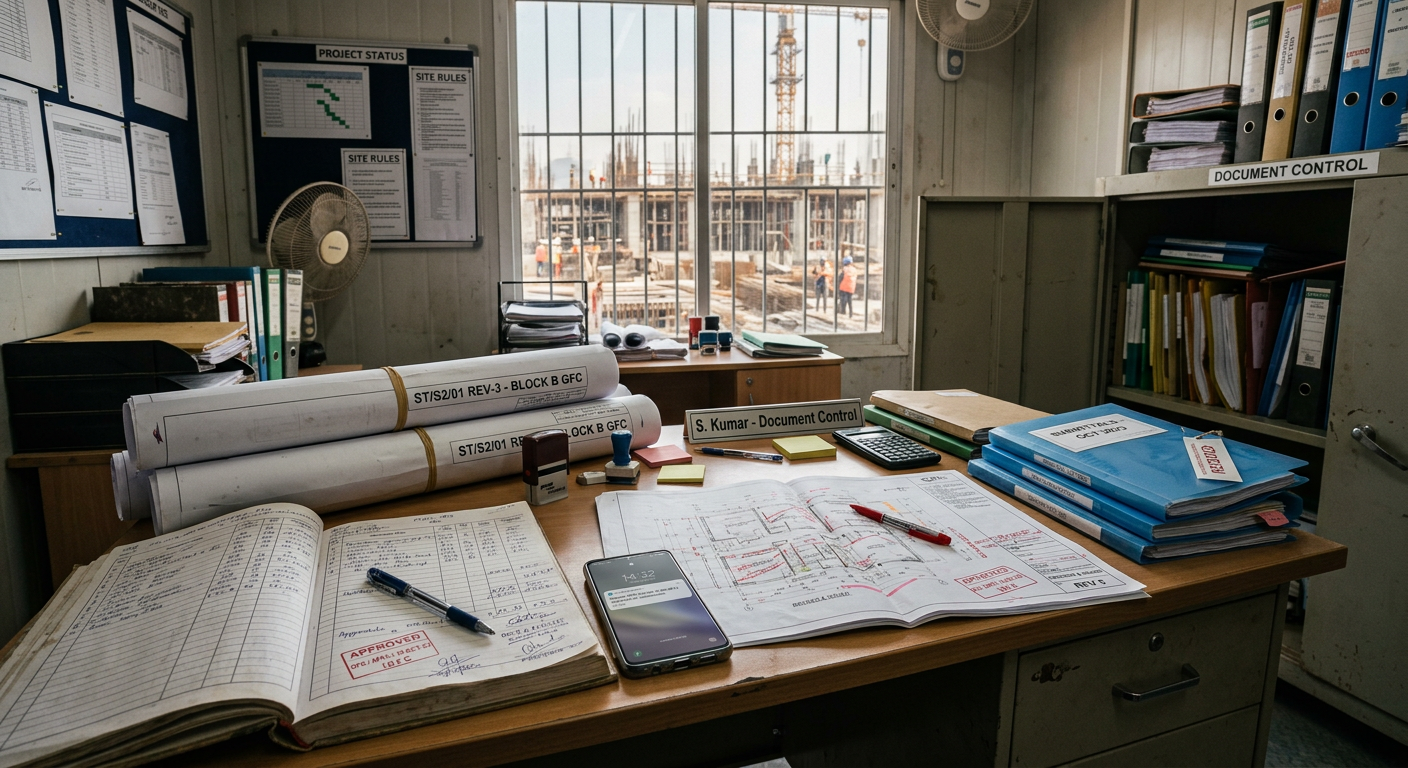
Walk into any Indian site office and you'll find the same setup: a steel almirah stuffed with blue folders, an inward/outward register with coffee stains on page 47, and a WhatsApp group called "Drawing Approvals Urgent" where critical GFC revisions disappear under good morning messages.
This isn't just messy. It bleeds money:
- Delayed RA certifications: When your billing engineer can't find the approved GFC revision that matches the executed work, the AE sits on your bill for weeks
- Dead EOT claims: Arbitrators have zero patience for "we sent an email" when you can't produce a signed acknowledgment or timestamped correspondence log
- Audit penalties: CPWD auditors don't negotiate when your muster rolls aren't serial-numbered or your material test certificates are scattered across three site offices
- Arbitration losses: Contractors regularly lose disputes not on merit, but because they can't produce the evidence chain
Document control isn't paperwork hygiene. On Indian construction sites—whether you're dealing with CPWD, state PWD, NHAI, or private developers—it's cash flow protection and claim defensibility. This guide covers how to implement controls that actually work under Indian regulatory requirements, including CPWD Manual 2019 compliance, folder structures that government auditors expect, and digital workflows that function when your site internet is down.
Learn how construction document management software automates these controls.
What Is Construction Document Control?
Construction document control is the systematic management of project documents across five pillars:
| Control Pillar | Purpose | Indian Context Example |
|---|---|---|
| Creation | Ensure documents are generated with proper authorization and format | DPR signed by authorised site engineer with company stamp |
| Distribution | Deliver documents to the right stakeholders with proof of receipt | RFI transmitted to PMC with email read receipt or physical acknowledgment |
| Revision Tracking | Maintain clear version history with approval trails | GFC drawing revisions logged with AE approval dates |
| Access Control | Restrict viewing/editing based on role and need | Contract documents visible only to contracts manager and project head |
| Retention | Preserve documents for contractually mandated periods | RA bills and MBs retained for 5+ years per CPWD requirements |
The key difference from simple file storage? Document control creates an audit trail—proving who created what, when it was approved, and who received it. When the arbitrator asks "Did the contractor give notice of delay within the contract period?" or the AE questions your quantities, this trail is your defense.
The Indian Construction Document Ecosystem
Government projects in India don't just suggest documentation—they mandate specific registers and retention rules that can make or break your audit.
CPWD Manual 2019 Requirements
The CPWD Manual Volume 1 (2019) specifies non-negotiable records:
- Measurement Books (MB): Serial-numbered, page-sequenced records. Lose the sequence, and the auditor rejects your bills.
- Muster Rolls: Daily attendance complying with labour welfare requirements
- Cash Books: Project-wise financial transactions
- Stock Registers: Material receipts and issues with running balances
- Indent Registers: Material requisitions with approval chains
Contract-Specific Document Schedules
Most CPWD, state PWD, and NHAI contracts include a Document Schedule that becomes a compliance checklist:
- Monthly progress reports with photographs
- Quality control test reports (NABL accredited labs only)
- Safety compliance certificates
- Environmental clearance monitoring reports
- Insurance policy renewals
Statutory Registers vs. Project Documents
| Statutory Registers | Project Documents |
|---|---|
| Required by labour/contract laws | Required by contract agreement |
| Inspected by labour officers/PWD auditors | Reviewed by AE/PMC/consultants |
| Standard formats (e.g., Form I for muster rolls) | Project-specific formats |
| Retention: 3-10 years per statute | Retention: Defects liability period + 5 years |
Mix these up, and you might discard statutory registers when the project closes—exposing yourself to penalties years later.
The Real Cost of Poor Document Control on Indian Sites
The Mumbai Metro Billing Disaster
A contractor submitted an RA bill for ₹2.3 crores on a Metro project. The PMC rejected it outright—the GFC drawings attached were Revision C, while the AE's office had approved Revision D two weeks prior. The contractor spent 45 days scrambling between site offices to locate Revision D, paying interest on working capital while the bill sat uncertified. The delay cost more than the billing clerk's annual salary.
The Highway Arbitration Loss
A highway contractor claimed ₹4.8 crores for disputed rock excavation quantities. He had emailed RFIs questioning the rock classification but held no signed acknowledgment from the NHAI engineer. The arbitrator ruled that unsigned email queries don't constitute valid notice under the contract. Claim denied. The excavation was done, the dispute was real, but the documentation was soft.
The PWD Audit Penalty
A state PWD audit found structural steel test certificates scattered across three site offices with no central register tracking them. The auditor levied a 2% penalty on the certified bill amount (₹86 lakhs) for non-compliance with quality documentation requirements. The steel was proper, the tests were done, but the control was missing.
These aren't hypotheticals. This is Tuesday on an Indian construction site.
Manual vs Digital Document Control: A Side-by-Side Comparison
| Aspect | Manual Register-Based Control | Digital Document Management System |
|---|---|---|
| Document retrieval | 15-45 minutes searching physical files | <30 seconds with metadata search |
| Version conflicts | Common (multiple copies in circulation) | Eliminated (single source of truth) |
| Approval tracking | Physical movement register, easy to miss | Digital workflow with stage visibility |
| Offline access | Full (paper is always available) | Available with sync-when-online architecture |
| Audit trail | Hand-signed initials, forgeable | Timestamped digital signatures, tamper-evident |
| Backup/disaster recovery | Photocopies in separate location | Automated cloud backup with versioning |
| Multi-stakeholder sharing | Physical couriers, delays | Instant secure links with access control |
| Cost for 100-cr project | ₹8-12 lakhs (files, storage, clerks) | ₹3-5 lakhs (software + training) |
The hybrid reality of Indian construction—where PMC engineers work from remote offices and site connectivity drops during monsoons—makes offline-capable digital systems essential rather than optional.
Superwise's document management system handles this with offline sync built for Indian site conditions.
Essential Documents Requiring Control
Category 1: Contract Documents
- Signed agreement with all annexures
- Letter of acceptance (LOA)
- Bank guarantees (performance, advance payment)
- Insurance policies
- Correspondence creating contract variations
Category 2: Design and Drawings
- Good-for-construction (GFC) drawings
- Approved construction methodology drawings
- As-built drawings
- Shop drawings for precast/steel elements
- Drawing revision registers
Category 3: Correspondence and RFIs
- Site instructions from AE/PMC
- Request for information (RFI) with responses
- Minutes of site meetings
- Notices under contract clauses (delay, variation, force majeure)
Category 4: Billing and RA Documents
- Measurement books (MB)
- Digital measurement book entries
- Running account bills (RA Bills)
- Supporting calculations and abstract sheets
- RA bill certification correspondence
Category 5: Compliance and Safety Records
- Quality control test reports
- Safety inspection reports
- Environmental monitoring records
- Labour muster rolls and wage registers
Category 6: Delay and Claims Evidence
- Hindrance register with photographs
- Daily progress reports (DPR)
- Construction daily report entries
- Construction hindrance/delay log with date-stamped evidence
Each category needs different retention periods and access controls. Billing documents stay restricted to the billing engineer and PM; safety records need to be accessible to all site staff for immediate reference.
Document Control Procedures: Step-by-Step Implementation
Step 1: Establish Folder Structure
Build your folders the way auditors and PMCs actually search for documents:
PROJECT-YYYY-XXX/
├── 00_CONTRACT/
│   ├── 01_Agreement_and_LOA
│   ├── 02_Bank_Guarantees
│   └── 03_Insurance
├── 01_DRAWINGS/
│   ├── 01_Architectural_GFC
│   ├── 02_Structural_GFC
│   └── 99_Revision_Register
├── 02_CORRESPONDENCE/
│   ├── 01_Inward_Letters
│   ├── 02_Outward_Letters
│   └── 03_RFI_Tracker
├── 03_BILLING/
│   ├── 01_Measurement_Books
│   ├── 02_RA_Bills
│   └── 03_Payment_Certificates
├── 04_COMPLIANCE/
│   ├── 01_QC_Reports
│   ├── 02_Safety_Records
│   └── 03_Labour_Registers
└── 05_CLAIMS_EVIDENCE/
    ├── 01_Delay_Notices
    ├── 02_Hindrance_Photos
    └── 03_Meeting_Minutes
Step 2: Implement Naming Conventions
Standardized filenames save hours during billing crises:
[DocType]_[Date]_[Reference]_[Revision].[ext]

Examples:
RA_Bill_20250115_RAB-12_Rev0.pdf
RFP_Response_20241203_RFI-045_RevB.dwg
Hindrance_Photo_20250110_TowerA_Foundation.jpg
Step 3: Define Revision Numbering
| Document Type | Numbering Scheme | Example |
|---|---|---|
| Drawings | Letter sequence (A, B, C...) | GFC-STR-001_RevD |
| Correspondence | Numeric with amendment suffix | Letter-045_Rev1 |
| Bills | Numeric with date | RAB-12_Rev0_20250115 |
Never use "Final" or "Latest" in filenames. Revision E always follows, and then you look foolish.
Step 4: Create Distribution Matrices
Define who gets what and how:
| Document Type | Internal Recipients | External Recipients | Method |
|---|---|---|---|
| GFC Drawings | PM, Site Engineer, Billing | AE, PMC, Contractor | Email + DMS link |
| RA Bills | PM, Billing Head | AE, Accounts | Portal upload + physical (if required) |
| RFI | Technical Team | PMC, Designer | Email with read receipt |
| Delay Notice | Legal, PM, Contracts | AE, PMC | Registered post + email |
Step 5: Set Retention Schedules
| Document Category | Retention Period | Trigger Event |
|---|---|---|
| Contract documents | 10 years | Final payment |
| Drawings (as-built) | Defects period + 10 years | Project completion |
| Billing documents | 8 years | Final RA certification |
| Correspondence | 10 years | Contract closure |
| Labour registers | 5 years | Date of last entry |
| QC test reports | 10 years | Date of testing |
Document Control for Billing & RA Certification
AE and EE offices verify four things before certifying your bill:
- Measurement continuity: Current quantities follow logically from previous certified amounts
- Drawing alignment: Executed work matches the approved GFC revision
- Rate applicability: Items claimed use the contract BOQ rate or approved variation rate
- Supporting evidence: Photos, test reports, and approval letters are attached and dated correctly
A digital document management system links these elements—connecting measurement entries to specific drawing revisions, and bills to supporting documents. This reduces AE queries from "Please clarify" to "Certified."
Critical controls for billing: - Maintain a running register of certified quantities (prevents double-claiming) - Store date-stamped photographs linked to measurement entries - Track drawing revisions that affect quantities (design changes often justify variations) - Archive AE observation letters and responses (shows proactive compliance)
Document Control for EOT Claims & Arbitration
Extension of Time claims live or die on documentary evidence. Indian arbitrators look for:
The Evidence Chain
- Notice: Did you notify the AE of the delay event within the contractually required window (usually 14-28 days)?
- Impact demonstration: Does the delay event actually hit the critical path?
- Mitigation: Did you attempt to reduce the impact?
- Quantum: Is the delay period calculated correctly with daily records?
Critical Documents for EOT Claims
| Claim Type | Essential Documents | Retention Format |
|---|---|---|
| Site hindrance | Hindrance log with photos, DPR entries | Digital with GPS timestamp + physical register |
| Drawing delays | RFI tracker, drawing approval dates, correspondence | Email archives + letter acknowledgments |
| Variation orders | VO approval letters, revised drawings, rate approvals | Original signed copies + scans |
| Force majeure | News reports, government orders, photographs | Multiple sources with dates |
| Labour/material shortage | Indent records, PO delays, correspondence | System records with timestamps |
Timestamp integrity is everything. Arbitrators scrutinize whether documents were created contemporaneously or backdated during claim preparation. Digital systems with automatic timestamping provide stronger evidence than manually dated registers that could have been filled in yesterday.
How Structured Documentation Powers AI Assistants
Teams using structured document management systems gain a secondary benefit: their documentation becomes accessible to AI assistants through Retrieval-Augmented Generation (RAG).
When your project documents carry consistent metadata—project IDs, document types, approval stages, dates—AI assistants can:
- Answer contract queries: "What was the approved rate for PCC M25 in Variation Order 3?"
- Generate status reports: "List all pending RFIs older than 15 days"
- Assist with claims preparation: "Compile all correspondence related to Tower A foundation delays"
- Check compliance: "Verify if all steel test reports for December are uploaded"
Superwise's Help Agent uses this structured storage to provide context-aware assistance. The same discipline that protects you in audits—consistent naming, metadata tagging, revision history—makes your project knowledge queryable, reducing the hours engineers waste searching for information.
Evaluating Document Control Software: What Indian Teams Should Look For
When selecting a system for Indian projects, verify these capabilities:
Offline Synchronization
Site offices often have poor connectivity. The system must allow document creation, annotation, and approval assignment offline, with automatic sync when connection resumes.
Approval Workflows
Support multi-stage approval chains matching your organization—site engineer → project manager → head office → client/PMC.
Audit Trails
Every action (upload, view, edit, approve) logged with user ID and timestamp—essential for arbitration evidence.
Mobile Capture
Site engineers photograph work progress and upload directly from mobile devices with automatic GPS tagging and timestamp.
Role-Based Access
Granular permissions ensuring contract documents are visible only to authorized personnel, while safety records are accessible to all site staff.
Integration with Billing
Documents should link to measurement sheets, RA bills, and payment workflows—creating a unified project record.
Explore construction site management software with integrated document control.
Takeaway Template: Document Control Starter Pack
Starting from scratch? Use this framework:
Folder Structure Template
- Master folder hierarchy (as outlined above)
- Subfolder naming conventions for each discipline
- Archive folder structure for completed projects
Naming Convention Guide
- Standard formats for drawings, correspondence, bills, and photos
- Revision numbering schemes by document type
- Examples of correct and incorrect filenames
Pre-Construction Document Index
- Checklist of documents required before work starts
- Responsibility matrix (who provides what)
- Delivery timeline aligned with mobilization schedule
Monthly Audit Checklist
- Documents to verify each month
- Common gaps and how to address them
- Sign-off format for project manager review
Download the ready-to-use files for this article:
Complete implementation toolkit containing folder structure templates, naming convention guide, pre-construction document index, and monthly audit checklist for CPWD/PWD/NHAI projects. Best format: Excel, because this asset is meant to be edited and reused on-site. - Download Excel template
Conclusion: Building Your 30-Day Document Control Implementation Plan
Document control isn't about creating more paperwork—it's about organizing the paperwork that already exists so it works for you rather than against you.
Week 1: Audit existing documents. Identify what's missing, what's duplicated, and what revision conflicts exist.
Week 2: Implement the folder structure and naming conventions. Train site engineers on the new system.
Week 3: Migrate active project documents to the new structure. Prioritize current billing and correspondence.
Week 4: Establish monthly audit routines. Review what's working and refine the system.
For teams ready to move beyond manual registers, digital document management systems offer audit-ready control with less administrative overhead. The investment pays for itself through faster RA certifications, defensible EOT claims, and reduced audit risk.
Download the free Document Control Starter Pack (includes folder structure template, naming convention guide, and pre-construction document index) or book a demo to see how Superwise automates document control for Indian construction teams.
FAQ
What is the difference between document management and document control in construction? Document management is storage and retrieval. Document control adds revision tracking, distribution records, and audit trails—proving not just what the document says, but when it was approved and who received it.
How long must construction documents be retained in India? Contract documents and billing records: typically 8-10 years from final payment. Labour registers: 5 years from the last entry. Check your specific contract conditions and applicable statutes (Building and Other Construction Workers Act, Limitation Act 1963).
What documents are required for RA bill certification? Typically: measurement book entries, GFC drawings showing executed work, quality test reports, photographs of work, previous RA bill copies, and any variations approved for the work claimed.
How do I prove a delay claim without written acknowledgment from the AE? Create contemporaneous records: hindrance registers with photographs, DPR entries noting the obstruction, emails or WhatsApp messages marking the date, and any independent evidence (news reports for force majeure, government orders). Arbitrators give weight to consistent contemporary records even without formal acknowledgment.
Can digital documents be used as evidence in Indian arbitration? Yes. The Information Technology Act 2000 and amendments recognize electronic records and digital signatures. However, ensure your system maintains timestamp integrity and access logs. Courts prefer documents from systems with clear audit trails over simple file storage.
What is a Document Control Starter Pack? It's a downloadable toolkit containing folder structure templates, naming convention guidelines, pre-construction document checklists, and monthly audit checklists—everything needed to implement document control on a new or existing project.


